From weathering to thriving together: A more human route to climate resilience
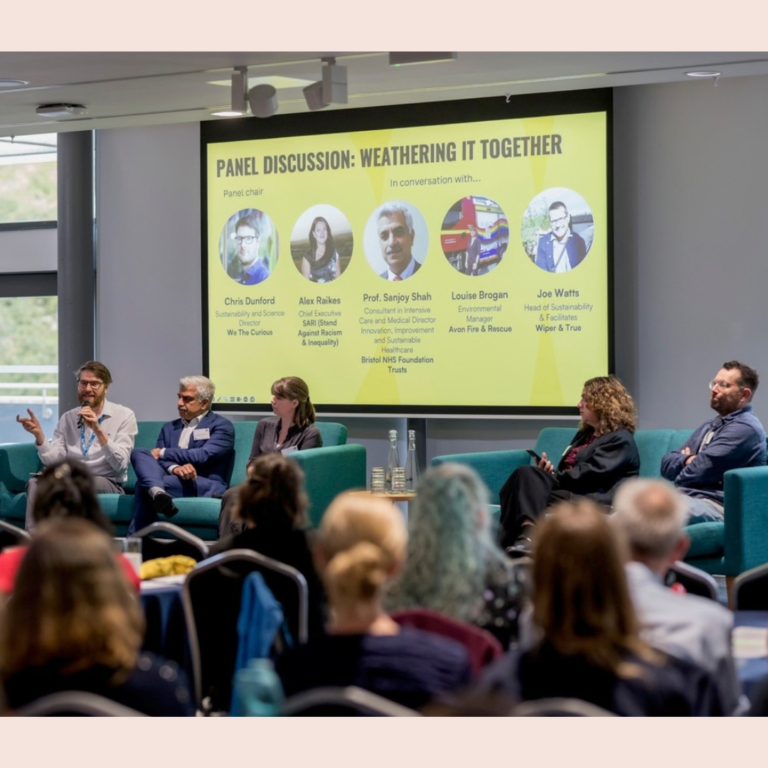
This October, Bristol Climate & Nature Partnership brought together businesses, community organisations and leaders from across the West of England at our climate resilience Gathering ‘Weathering it Together’. In this blog, climate, poverty, and equity advisor Liz Gadd shares her reflections on the day and key takeaways.
The event title implied facing and surviving a difficult period, crisis or hardship collectively rather than alone. Whilst that may be true, I left the day feeling a sense much closer to thriving than weathering together.
The room was brimming with passion, knowledge and networks. Much of the infrastructure for climate resilience already exists, in councils and emergency services, but also in food clubs, libraries, schools, faith groups, local businesses, WhatsApp groups and amongst neighbours. The challenge is connecting and resourcing what is already there. So what did conversations suggest we need to do next?
1. Integrating informal and formal ecosystems
Years of underinvestment have resulted in fragmentation within both formal and local community infrastructure – from flood wardens to sports groups. Listening to the conversations, it was clear that everyone in the room was keen to learn more about what each group is doing and how they can collaborate. The trouble is that such opportunities are so rarely funded. This gathering, supported by Bristol Water and the West of England Combined Authority, was as unusual as it was special. For me the difficulty is that we are only touching the surface of the relationship building needed to integrate formal and informal ecosystems. Groups need to be funded together, convened strategically and over time, if they’re going to become more like a mycelium network, sharing resources, knowledge, agency and joy together.
2. We need to invest in places people meet
I heard lots of conversations about having “spaces to gather and convene” and the importance of existing community spaces. People repeatedly pointed to community centres, village halls, libraries, community hubs, faith spaces, parks, gardens, sports clubs and youth clubs as part of the resilience infrastructure. In the digital age these places are not always physical either, WhatsApp, Facebook groups and trusted local information sources all have a role.
Climate resilience needs more and better supported places for people to meet and access support. This wasn’t a call to build more venues, but to invest in existing accessible, trusted local places where people can meet, organise, share information, build relationships and get support.
With the pragmatic realism communities often bring, I heard one conversation about being unable to imagine a world in which everyone is connected to everyone else as it would be completely overwhelming. Instead, they talked about creating the conditions for emergence, where the connections that need to be made can emerge. Whether in person or online, climate resilience depends on useful information travelling through spaces and networks people already use and trust.
3. Moving from emergency service recipients to active preparedness
In the world many of us grew up in, emergencies were almost always unexpected. This is no longer the case, and we know more heat, drought, wildfire, floods, and storms are in our future. Whilst we can continue to mitigate the risks by rapid decarbonisation, some of the impacts are inescapable and we need to prepare.
There is growing emergency preparedness within some communities, for example Disabled communities, where people are learning from what others already do, maximising existing community held expertise. The potential of informal and formal ecosystems building climate resilience together is enormous, but to do so we have to stop thinking that anything emergency related is a surprise where experts respond with little or no engagement from communities.
4. Move from pilot and test to roll out and scale up
Communities and seasoned professionals alike are increasingly clear about what is needed. Conversations reflected a call to scale up, underpinned by a weariness with endless pilots and trials. Communities are frustrated with politicians, funders and decision makers holding back rapid action at scale through short-term leadership and competitive funding that creates a scarcity mindset. As I half-joked in my presentation, if we want communities to act like mycelium networks, we need to stop treating them like mushrooms, fed on s**t and kept in the dark.
Many of the organisations carrying resilience capacity are not dedicated climate organisations. Highly restricted climate funding can struggle to reach the infrastructure participants believe matter most. Plus most social funders are still early in their journey to embed climate adaptation and resilience into highly stretched funding programmes. More intersectional action has the potential to make money go further and increase impact.
There are signs of movement, including the new Community Climate & Nature Action Fund launched by Bristol Climate & Nature Partnership and Quartet Community Foundation on the day of the gathering. The fund is designed to get money directly into locally identified climate and nature priorities. Thousands of residents have been involved in developing the priorities, with more than half new to climate and nature action.
5. Food as a metaphor for just resilience
Food appeared to be one of the strongest shared themes whether through food banks, community farms, allotments, community gardens or simply the joy of eating together.
It connects immediate need, affordability, health, community, land and nature, local supply, skills, and resilience to disruption. It also gives us a very personal way into questions of justice, both in society today and in how we build climate resilience.
For many in the room, food offered a practical entry point into wider community resilience work.
Perhaps that suggests an underexplored opportunity. Let’s have more meals together strengthening climate resilience by strengthening our local and regional relationships.
Dinner anyone?
Share to