Building a case for council-backed, community-led climate action
Mark Leach, Climate Engagement Coordinator at Bristol City Council, has been a key part of our Community Climate & Nature Action Project since it began six years ago. In this blog he shares some tips for councils from our collaborative approach to community-led climate and nature action.
I sometimes hear people talk about a ‘backlash’ against net zero. That particular term has caused some confusion. As a result, it has been picked up and used as a rallying point by a small but vocal group of political activists whose views sit well outside the mainstream—and are not reflective of wider public opinion. We know support for climate and nature action remains high nationally.
We know that from evidence as well as from our own conversations. And we know it from the sheer numbers of people involved in projects across the country.
However, the narrative has gained traction. National and local Government will need to find a way to respond to it. This is where the Community Climate & Nature Action (CCNA) approach offers a practical way forward.
It’s not climate- nature-led, it’s people-led.
By starting from where people are at, the CCNA model links up real-life challenges and opportunities with climate and nature solutions. CCNA has involved teams from across the council. Transport, Parks, Public Health, Regeneration, Energy, Community Development, Waste Services, Policy, Economic Development, Culture and of course Councillors have all been involved. That breadth means this approach can help dovetail community priorities with existing council priorities, and budgets.
Uniting frames: We need this now more than ever
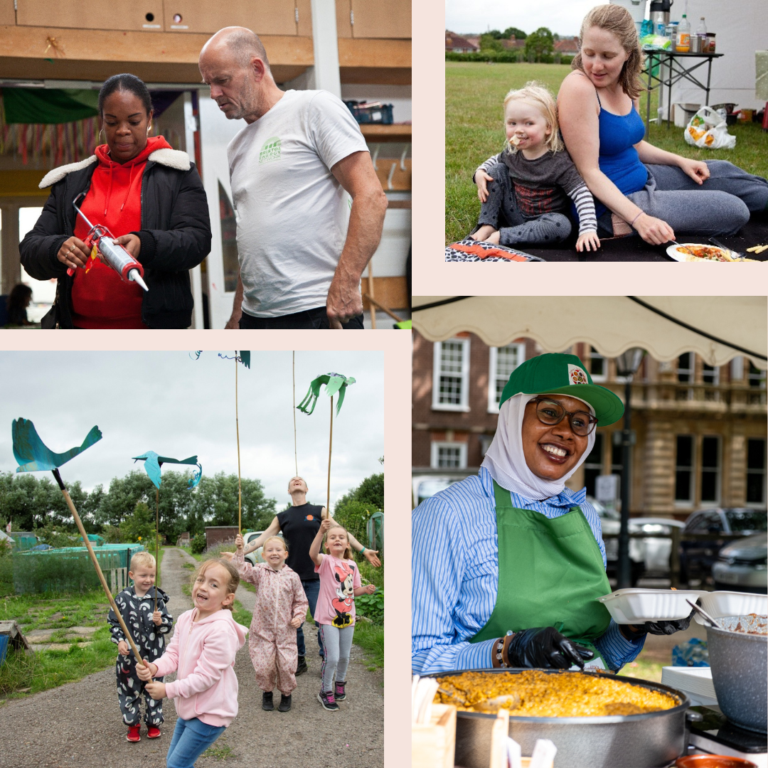
The idea for this blog came from reviewing photographs from events communities across Bristol held over the last few years. Looking at them, I reflected that I would be interested to meet anyone who’s reaction looking at these is to say ‘let’s have less of this’.
Do we want children to have a chance of some healthier food, of getting their hands dirty growing or cooking instead of being stuck inside or on a screen?
Do we want to upskill local residents on draughtproofing, energy saving and how to make homes less damp and cut bills? I mean it sounds like a rhetorical question, doesn’t it?

Sally Collister / BCC
Build from what you have
What we’ve seen in practice is that this approach doesn’t require a perfect starting point, with everything in place. It works in different types of communities and with different council structures because it builds from what is already there. Small, practical activities – which often don’t appear climate change focused – can lead to wider engagement, stronger relationships and new opportunities for funding or service improvement. Community climate and nature action might be less about launching a new initiative and more about connecting existing work in a way that delivers greater impact.
Argh but we don’t have any funding
This work doesn’t require creating entirely new programmes or large amounts of additional capacity. It’s a great fit with what communities and councils do anyway.
The main shift is not resource, but mindset – a decision to connect existing work with what matters most to communities. Finding even small amounts of time can be a challenge for councils at the moment. But the CCNA approach fits with teams seeking evidence for funding calls, building cases for investment, improvements to services and public health objectives – particularly in those communities who are excluded or seldom heard. It’s about looking for good fit, with these areas of ongoing service delivery and with funding.
The Partnership also set up the Community leadership panel on Just Transition which has been a highly effective and resource-efficient way of bringing perspectives from a very diverse range of excluded and marginalised groups into strategic and citywide projects, strategies and initiatives. Check out the Insights Report for the panel.
Taking two and tangoing
Where you have a strong third sector organisation to partner with, delivery becomes significantly easier and more effective. In Bristol we have the Partnership – but we know there are VSCE sector organisations in all parts of the country. Although it will be possible in some council areas with this, that brokerage role I’ve described previously here is invaluable in delivering buy-in, continued engagement and getting expert input in the round. From relevant third sector organisations such as wildlife trusts and transport organisations as well as local authorities.
You’re keen but cautious – what next?
If you think this might be really challenging but you can see the need and want help justifying and making a case internally and seeking resources or if you’re exploring how to start, I’d be very happy to talk. Get in touch via contact@bristolclimatenature.org.
Find out more about the Community Climate & Nature Action Project
Share to