Have you been briefed?
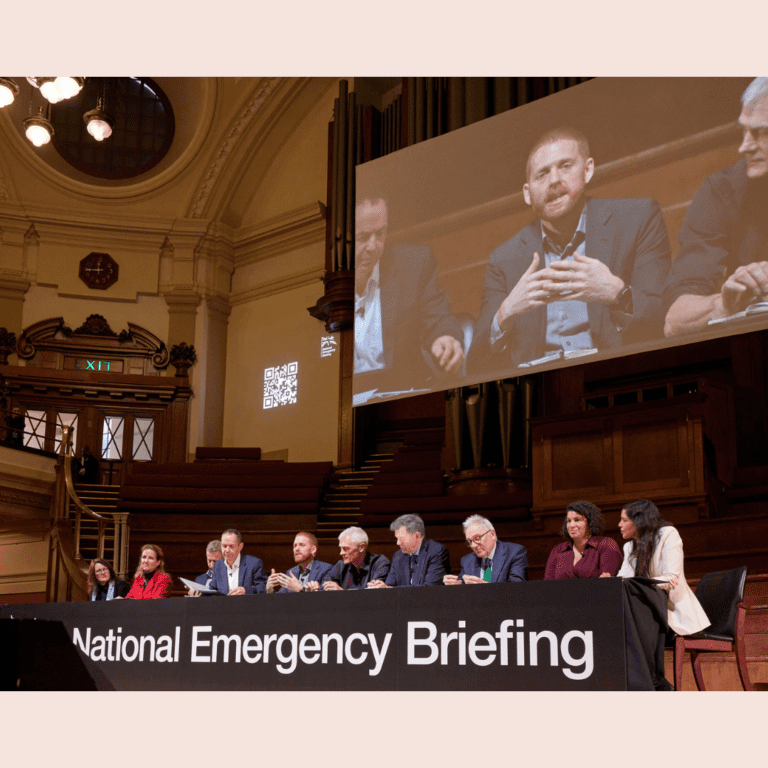
In November last year, ten leading experts briefed an invited audience of over 1,200 politicians and leaders from business, culture, faith, sport and the media on the comprehensive implications of climate and nature breakdown for health, food systems, national security and the economy. It was called the National Emergency Briefing. In this blog post, our CEO Lizzi Testani reflects on attending the briefing and plans for screenings across the UK.
The National Emergency Briefing was unlike anything I have attended before.
Having joined the London Climate Marches nearly 20 years ago and Extinction Rebellion demonstrations in 2019, this felt like another important moment in our country’s climate and nature journey. I wanted to be there, so I wrote to the organising group asking for an invite, which they extended.
I was struck by the queue to get into Westminster’s Central Hall, which wrapped around two sides of the building – and the mood was palpable.
In recent years it has been strange and exhausting to see the mounting evidence on the realities of climate change and nature loss be so frequently ignored, contested or disregarded.
The information presented during the National Emergency Briefing was indeed sobering. But that these facts and their implications for the UK were now being consolidated and shared, alongside so many existing solutions to the issues raised, felt like cause for optimism, albeit combined with the difficult emotions that come with confronting how serious the risks are.
Chris Packham’s opening words were an invitation to re-discover wonder for the intricate ecosystem that we humans are part of and depend on. I learned more about the earth’s expansive regulatory systems and the way they move in balance to keep our planet habitable. We also heard the extent to which these systems are now at risk.
But, despite concerns raised about whether the country is ‘ready’ to face another emergency – as if we get to choose the timing of such things – my mind keeps returning to the fact that I don’t believe we are facing ‘yet another’ one. The information contained in the briefing is not new, or separate. The National Emergency Briefing showed clearly how climate and nature issues are deeply intertwined with the other major geopolitical, economic and social shocks of the last few years.
This is precisely what makes the National Emergency Briefing’s framing distinct. It’s not about adding another crisis to the pile, it’s about seeing clearly what connects them all.
Now the information is being taken nationwide. A 45-minute film called the People’s Emergency Briefing will bring the same evidence presented in November into communities across the UK from 7 April.
Screenings, hosted by organisations of many different types, will bring residents, community leaders and MPs together to hear the evidence and consider what a proportionate national response should look like.
By encouraging collective viewing, the initiative aims to cut through disinformation, establish a common understanding of the risks, and support constructive civic engagement about what happens next.
I understand that not everyone will want to watch, just as I’m aware that the tone of this communication about climate and nature isn’t for everyone. There is a legitimate debate about whether leading with a focus on risk and urgency motivates or causes people to disengage.
The evidence presented may bring up feelings of concern, grief or trepidation, and those responses are valid. Even so, there are moments when it feels important to see the full picture, to be in a better position to decide what to do next. The People’s Emergency Briefing feels like one of these moments – an honest acknowledgement of where we stand in the UK’s climate and nature journey.
Without prescribing policy solutions, it aims to create a shared basis for future decisions and communicate clearly that the climate and nature crises will shape our futures whether we choose to act or not.
At a moment when the next steps we take on climate and nature feel so consequential, this effort matters.
We will be watching the People’s Emergency Briefing together as a team of staff and directors and considering what it means for our work.
For members that may wish to attend and engage local screenings, you can find out where they are being held via the National Emergency Briefing’s online map.
If the briefing provides new inspiration or ideas for action on climate and nature, we’d love to hear from you. For more information about how you can get involved in Bristol Climate & Nature Partnership visit: https://bristolclimatenature.org/get-involved/.
Upcoming screenings around Bristol
We’ll regularly update this list. You can also keep an eye on newly organised screenings via the online map.
Windmill Hill, 17 Oct – book here
Bristol City Centre, 20 Oct – book here
Clifton, 21 Oct – book here
Frenchay, 23 Oct – book here
Eastville, 26 Oct – book here
Brislington, 29 Oct – book here
Bedminster, 30 Oct – book here
Bristol City Centre, 3 Nov – book here
Knowle West, 3 Nov – book here
Keynsham, 4 Nov – contact organiser via online map
Kingswood, 4 Nov – contact organiser via online map
Pill, 6 Nov – book here
Bedminster, 7 Nov – book here
Clifton, 12 Nov – book here
Southville, 13 Nov – book here
Easton, 19 Nov – book here
Bristol City Centre, 25 Nov – book here
Old Market, date TBC – stay updated here
Downend, date TBC – stay updated via online map
View all screenings on online map
Further reading
- For more information about the briefing, visit National Emergency Briefing
- To support hosts, the Climate Psychology Alliance and National Emergency Briefing are running workshops for People’s Emergency Briefing facilitators to understand how to help people hear, process and discuss difficult information.
Share to